

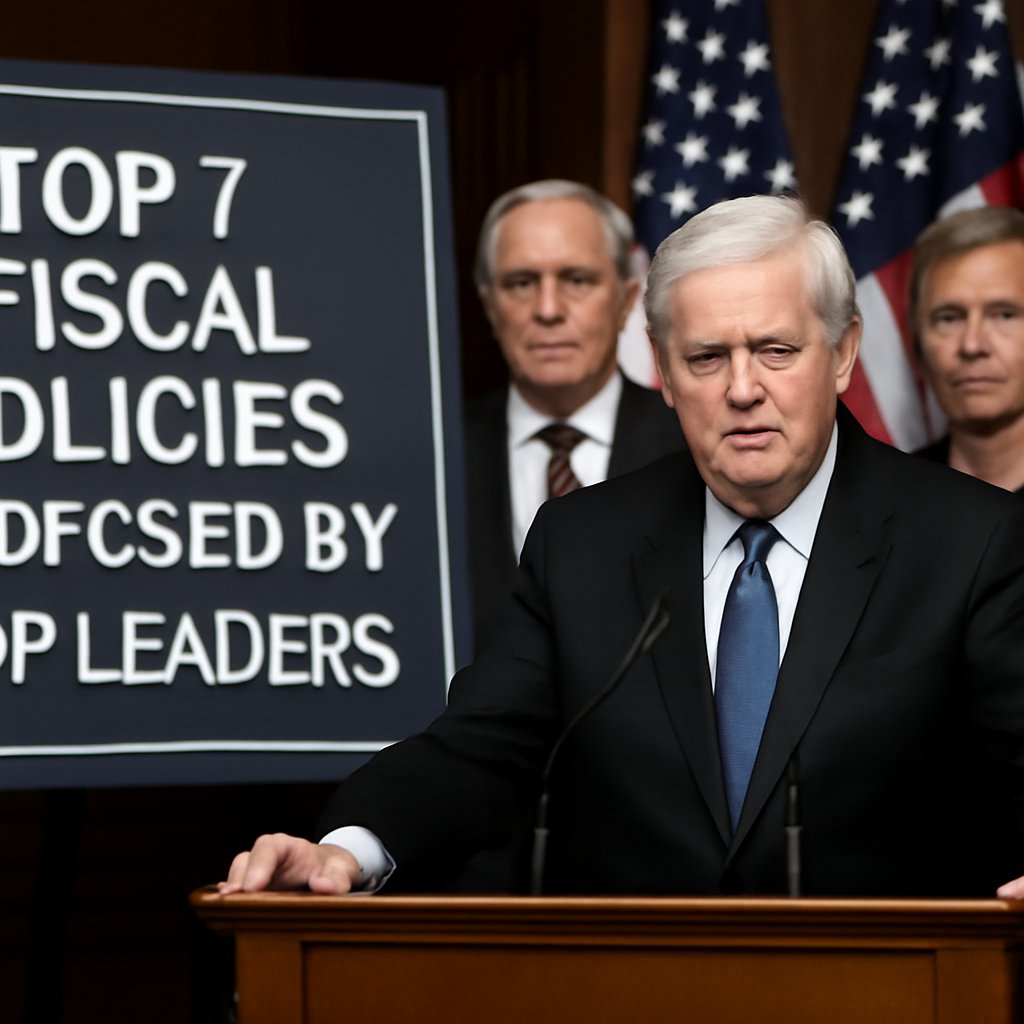
In today’s political landscape, the fiscal policies proposed by GOP leaders stand out as essential blueprints for economic growth, reduced government overreach, and enhanced national security. These Republican party initiatives prioritize tax relief, spending restraint, and targeted investments that directly bolster border security while addressing ballooning deficits.
Talking to voters in communities across the country, one hears again and again how federal tax burdens squeeze the very small businesses that anchor state economies from Texas to Ohio. Republican leaders consistently advocate extending the 2017 Tax Cuts and Jobs Act provisions to prevent automatic tax hikes on families and businesses. This approach keeps more money in the hands of American workers, fueling job creation and wage growth across key industries. By making these cuts permanent, GOP fiscal policies proposed by leaders aim to stimulate long-term investment without increasing the national debt burden.
The rationale behind permanent tax cuts extends beyond immediate relief. Conservative economists argue that temporary tax provisions create uncertainty for business planning and capital allocation. When companies don’t know whether tax rates will rise in a few years, they hesitate to make long-term investments in equipment, facilities, and workforce expansion. Making the 2017 tax cuts permanent would remove this uncertainty, allowing corporations and small business owners to confidently commit resources to growth initiatives. This confidence translates into sustained economic expansion and more stable employment opportunities across diverse sectors.
Further reductions in the corporate tax rate to 15 percent represent another cornerstone. Such changes encourage domestic manufacturing and repatriation of overseas profits, directly supporting broader Republican goals of economic independence and reduced reliance on foreign supply chains. The grassroots conservative movement understands this instinctively: when states retain sovereignty over their own regulatory environments, small enterprises thrive without Washington dictating every compliance cost. Many GOP leaders point to the competitiveness factor, noting that the proposed 15 percent rate would still be higher than rates in some competing nations but would position America more favorably compared to the previous 35 percent rate.
Addressing unsustainable entitlement programs forms a critical part of the fiscal policies proposed by GOP leaders. Proposals include gradual reforms to Social Security and Medicare that protect current beneficiaries while introducing market-based options for future retirees. These measures seek to curb automatic spending growth and promote personal responsibility within the system. Rather than immediately cutting benefits for current recipients, these approaches typically include raising the retirement age gradually over decades, means-testing for higher-income beneficiaries, and allowing younger workers to direct a portion of their payroll taxes into personal investment accounts. Such reforms acknowledge demographic realities: people are living longer, and the worker-to-beneficiary ratio has declined significantly since these programs’ inception.
Imposing strict caps on non-defense discretionary spending helps redirect resources toward priorities like border security. By trimming waste in federal agencies, these policies free up billions annually for enforcement operations along the southern border, including technology upgrades and personnel increases. GOP proposals often emphasize that agency consolidation and elimination of redundant programs can achieve these savings without reducing services to Americans who genuinely depend on federal support. Critics of big government point to numerous examples of duplicative functions across different departments where efficiency gains could be realized.
Integrating robust border security funding into overall fiscal frameworks ensures physical barriers, surveillance systems, and interior enforcement receive consistent support. GOP proposals tie this funding to deficit reduction targets, arguing that secure borders reduce long-term costs associated with illegal immigration and related public services. Supporters contend that upfront investments in border infrastructure and technology yield returns through reduced emergency room visits by undocumented immigrants, decreased strain on local school systems in border communities, and lower criminal justice costs associated with border-related crimes. These arguments frame border security not merely as a national security issue but as a fiscally responsible investment that prevents larger expenditures down the line.
Tax credits and deregulation for domestic energy production complement these efforts by lowering household energy costs and generating new revenue streams. This sector-specific strategy under Republican fiscal policy enhances energy exports while decreasing dependence on volatile global markets. American energy independence has emerged as a significant GOP priority, with proposals to streamline permitting for oil and natural gas development, expedite approvals for renewable energy projects on federal lands, and support investment in nuclear power infrastructure. Lower energy costs have cascading effects throughout the economy, reducing transportation costs, manufacturing expenses, and heating bills for American families and businesses alike.
Pushing for a constitutional balanced budget amendment remains a high-priority item among GOP leaders. This would enforce fiscal discipline across administrations and limit Congress’s ability to pass unchecked spending bills that exacerbate deficits. Proponents argue that states and families operate under budget constraints, and the federal government should too. A balanced budget amendment would require exceptional Congressional majorities to override during genuine emergencies, creating structural incentives for fiscal responsibility. Conservative legal scholars maintain that such an amendment would fundamentally reshape how Washington approaches spending without requiring year-to-year political fights over the deficit.
Pairing budget reforms with broad deregulation in banking and environmental sectors reduces compliance costs for small businesses. The result is accelerated economic activity that naturally expands the tax base without rate increases. GOP leaders frequently highlight studies showing that regulatory compliance costs disproportionately burden smaller firms that lack dedicated legal and compliance departments. By reducing unnecessary regulations while maintaining safety and environmental standards, these proposals aim to level the playing field between large corporations and smaller competitors. State sovereignty gains ground when constitutional conservatism reins in federal spending that otherwise crowds out local priorities.
The 2017 tax reforms added an estimated 6.5 million jobs before the pandemic disruptions. Border security enhancements proposed in recent GOP budgets total over $25 billion for wall construction and technology over five years. Entitlement spending currently accounts for more than 60 percent of the federal budget, driving annual deficits above $1 trillion. Corporate tax cuts have historically correlated with a 20 percent rise in business investment within two years of implementation. Energy production incentives under Republican policies contributed to the U.S. becoming a net energy exporter for the first time in decades. Discretionary spending caps enacted in prior agreements reduced non-defense outlays by 8 percent relative to baseline projections.
Republican fiscal strategies also emphasize reducing wasteful spending on foreign aid and international programs that many conservatives believe don’t serve core American interests. Proposals often include rigorous auditing of federal grant programs to eliminate fraud and misuse. Additionally, GOP leaders champion protecting American intellectual property and strengthening trade relationships that benefit domestic workers rather than outsourcing jobs overseas. These trade policies complement tax and regulatory reforms by creating a comprehensive economic framework designed to benefit American workers and businesses.
The fiscal policies proposed by GOP leaders collectively offer a roadmap for sustainable prosperity, stronger borders, and accountable government. By combining tax relief with targeted spending priorities, these Republican strategies position the nation for enduring strength amid global challenges. Whether through immediate tax relief, regulatory reform, or long-term entitlement adjustments, GOP proposals reflect conservative principles of limited government, fiscal responsibility, and economic freedom. Voters evaluating these policies can examine historical precedents and economic data to assess whether these approaches align with their own fiscal priorities and vision for America’s economic future.