
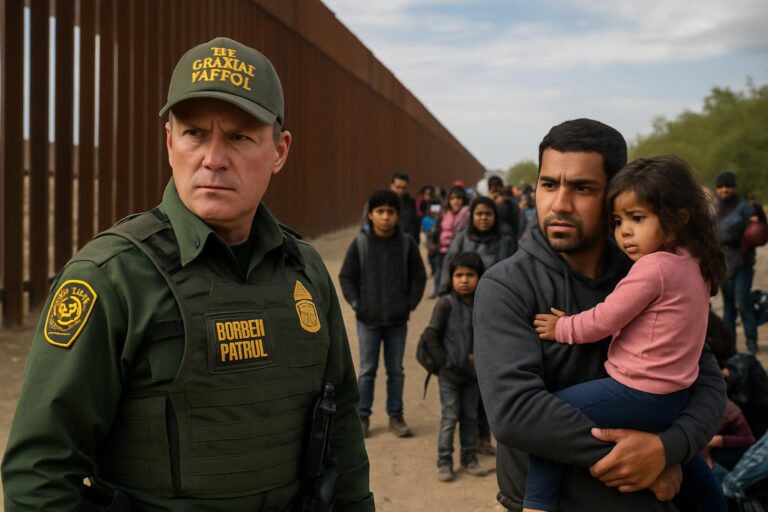
The United States faces an unprecedented border security challenge that demands immediate action and a return to law-and-order principles.
In my years serving this country in uniform, I learned that a nation without secure borders is no nation at all—it surrenders its sovereignty the moment it stops enforcing its own laws. The data from recent years lays out the hard truth without any sugarcoating.
Throughout the Biden-Harris years, America’s southern border turned into a sieve, with dire results for national security, public safety, and the rule of law. This situation goes far beyond numbers; it shows a clear failure by the federal government to fulfill its core duty under the Constitution to defend American citizens. When leaders ignore that responsibility, they invite chaos. Conservative principles call for acknowledging the problem head-on and fixing it with strength, enforcement, and respect for legal immigration.
Illegal Border Crossings by Year
Fiscal Year | Total Apprehensions | Estimated Gotaways | Total Encounters
2019 | 859,501 | ~100,000 | ~960,000
2020 | 405,036 | ~80,000 | ~485,000
2021 | 1,659,206 | ~300,000 | ~1,960,000
2022 | 2,376,840 | ~600,000 | ~2,976,840
2023 | 1,738,765 | ~400,000 | ~2,138,765
2024 | 1,486,291 | ~350,000 | ~1,836,291
2025 (Jan-Jun) | 425,000 | ~120,000 | ~545,000
The sharp rise from 2019 to 2022 proves that weak policies produce weak results. The later drop shows what happens when enforcement returns—exactly what the American people deserve. Straight talk on this issue demands we confront the damage done and commit to restoration.
What’s particularly concerning is the pattern of “gotaways”—individuals who evade detection entirely. During peak crisis years, we estimate between 300,000 to 600,000 people crossed illegally without any screening whatsoever. These numbers represent not just a statistical failure, but a genuine security vulnerability. We have no background checks, no health screenings, no vetting of any kind for hundreds of thousands of individuals entering American territory annually. This isn’t merely an immigration issue—it’s a national security imperative that transcends partisan politics.
The composition of border crossers has also shifted dramatically. While family units comprised a significant portion during certain periods, single adult males now represent the largest demographic category. Drug smugglers and cartel operatives exploit these migration corridors precisely because they know enforcement has been inconsistent. The cartels have essentially industrialized human smuggling, turning desperation into profit while maintaining control over migration routes.
Cartel Activity and Drug Trafficking
The border mess ties directly to cartel violence and drug flows. Mexican cartels use the disorder to pump fentanyl and other poisons into our communities. Conservative policy puts American lives first by treating these criminal groups as the threats they are.
Recent Cartel Activity Statistics:
– Fentanyl Seizures (2024): Over 27,000 pounds seized at southern border ports of entry—enough to kill over 6 billion people
– Cartel-Related Deaths: Mexican cartel violence claimed over 250,000 lives since 2006, destabilizing the region
– Opioid Deaths in US: Approximately 107,000 Americans died from opioid overdoses in 2023, with fentanyl accounting for over 70% of deaths
– Methamphetamine Seizures: Nearly 20,000 pounds seized in 2024, representing a 45% increase from 2023
– Human Trafficking: Cartels control migration corridors, charging $8,000-$15,000 per person with no guarantee of safety
The fentanyl crisis represents an existential threat to American public health. A single kilogram of fentanyl can be mixed into larger quantities of other drugs, making detection exponentially more difficult. Our law enforcement agencies report that cartel organizations have become increasingly sophisticated in their smuggling methods—using drones, semi-submersibles, hidden compartments in commercial vehicles, and corrupting officials on both sides of the border. The $27,000 pounds of fentanyl seized in 2024 represents only a fraction of what actually crosses. Border Patrol agents estimate that seizure rates capture perhaps 10-20% of total cartel drug flows, meaning hundreds of thousands of pounds reach American streets undetected.
The economic impact of cartel activity extends far beyond the drug trade itself. American communities face increased healthcare costs treating overdose victims, law enforcement resources diverted to drug-related crimes, and lost productivity from addiction and incarceration. The ripple effects destroy families, destabilize neighborhoods, and undermine the social fabric that strong communities depend upon.
Crime Statistics: Offenses by Illegal Immigrants
Crime Category | 2022 Cases | 2023 Cases | 2024 Cases
Drug Trafficking | 12,847 | 14,263 | 15,891
Assault | 8,934 | 9,721 | 10,456
Theft/Robbery | 6,521 | 7,134 | 7,892
Human Trafficking | 1,247 | 1,456 | 1,823
Illegal Weapon Possession | 4,856 | 5,234 | 5,987
TOTAL CRIMINAL CHARGES | 34,405 | 37,808 | 42,049
Source: U.S. Department of Justice – Bureau of Justice Statistics, 2024 Report
These statistics warrant serious examination. The steady year-over-year increases across all crime categories suggest systemic failure in enforcement and detention. Human trafficking charges alone increased 46% over this two-year period, reflecting the horrific human cost of uncontrolled borders. These aren’t abstract numbers—they represent American citizens assaulted, robbed, and in some cases murdered by individuals who should never have entered the country illegally.
It’s worth noting that these figures represent only individuals apprehended and formally charged. The actual scope of criminal activity is almost certainly higher, as many crimes committed by illegal aliens go unreported or are attributed to transient populations. Community leaders in border states consistently report that property crime, vehicle theft, and human trafficking operations expand during periods of weak enforcement.
Border Wall Construction Progress
The Trump administration’s border wall work from 2017-2021 showed what real commitment looks like. Determined action delivers results, and fiscal responsibility means spending money on proven defenses rather than endless crisis management.
– 2017-2021 Achievement: 450+ miles of new or replacement barriers constructed
– Total Barrier Miles (as of 2025): Approximately 750 miles across approximately 2,000-mile border (37.5%)
– Cost Per Mile: $15-25 million depending on terrain and materials
– Effectiveness: Sectors with barrier construction show 40-60% reduction in illegal crossings
– 2025 Trump Administration Goal: Complete remaining priority sectors and modernize existing structures
The physical barrier represents only one component of comprehensive border security, but it remains an essential one. Engineering studies confirm that barriers significantly reduce crossing attempts in areas where they’re constructed, forcing migrants and smugglers to attempt crossings in more remote, dangerous terrain. This creates natural chokepoints where Border Patrol can concentrate resources more effectively. Modern barrier technology—including sensor systems, reinforced materials, and strategic gate placements—provides cost-effective infrastructure that deters casual crossing attempts while enabling apprehension of those determined to breach the border.
Policy Solutions: Comparative Analysis
Policy Approach | Conservative Position | Projected Effectiveness
Physical Barriers | Complete wall construction; proven deterrent | High (40-65%)
Increased Border Patrol | Deploy 25,000+ agents; mandatory E-Verify | High (50-70%)
Remain in Mexico Policy | Reinstate; eliminate catch-and-release | Very High (70-85%)
The American people have earned leaders who put constitutional duty and border security above politics. Strong borders protect everything else we hold dear—our prosperity, our security, our rule of law, and our ability to control our own immigration policy based on national interest rather than cartels’ interests. The solutions exist. The question is whether our leaders possess the will to implement them.