

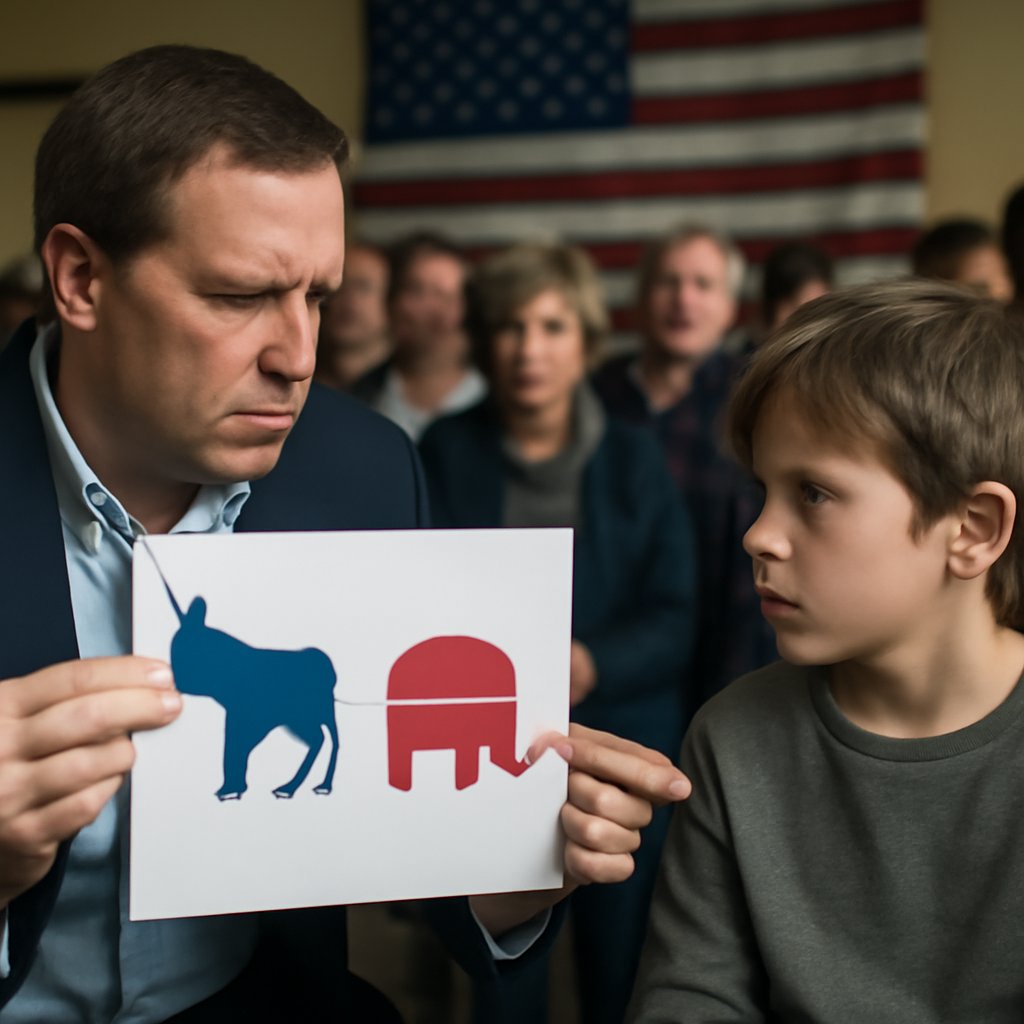
Teaching kids about the two major parties starts with honest conversations rooted in America’s founding principles rather than abstract school lessons. Parents across the heartland see this every day when children overhear discussions about taxes, schools, or elections. The grassroots conservative movement understands this instinctively: clear explanations build future citizens who value limited government and personal responsibility over endless federal expansion.
Why these distinctions matter becomes obvious once families connect them to real life in their states. America’s two-party system influences everything from local regulations to national policy, so children benefit from grasping the core divide early. This knowledge helps them evaluate news, respect differing family views, and appreciate how constitutional limits on power protect liberty at every level of government.
Republicans, often called the GOP, focus on keeping authority close to the people. They support smaller federal footprints so states can handle their own affairs under the Constitution, lower taxes that let small businesses and families retain earnings, and strong emphasis on individual effort instead of new Washington programs. Strong defense and secure borders also rank high because they safeguard the freedoms that allow communities to thrive without interference. A simple way to put it for a child is that Republicans want people and local leaders making decisions, not distant bureaucrats dictating outcomes.
Democrats, by contrast, favor a larger federal role to address problems through new programs and rules. They back higher taxes on successful earners to fund expanded services and push environmental and social policies enforced from the top down. For kids, this translates to the idea that government should collect more and decide how resources get shared.
Real-world examples make the contrast concrete without losing accuracy. Consider school needs in a state like Texas or Ohio: Republicans often point to local donations, parent involvement, and state-level choices that keep control nearer families and small businesses. Democrats tend to argue for federal tax dollars redistributed across districts. On a playground level, Republicans stress earning rewards through effort while still respecting rules set at the community level; Democrats stress engineered equality through outside mandates.
Talking to voters in communities across the country reveals a consistent preference for presenting both sides fairly so children learn to weigh ideas themselves. Avoid loaded labels, note that both sides claim good intentions, and encourage questions. This approach aligns with constitutional conservatism by treating politics as debate over principles rather than tribal loyalty. Age matters too—simple analogies work for younger kids while older ones can handle state sovereignty discussions and how the Tenth Amendment reserves powers to the states.
Key contrasts stay straightforward. Republicans back smaller government, broad tax relief that helps entrepreneurs, lighter regulations on business, restrained federal assistance, and protections against government overreach. Democrats lean toward bigger structures, targeted tax increases, heavier rules, expansive safety nets, and interventions framed around equality. Facts on these positions remain consistent regardless of viewpoint.
Building critical thinking means asking children why someone might favor state-driven solutions or why federal programs often grow beyond original intent. Point to evidence from state experiments in welfare or education reform. Recognize that emotions can cloud tradeoffs, yet remind them both paths carry consequences—especially when federal power crowds out small-business initiative or local accountability.
Many households already model respectful disagreement across party lines. Use those moments to show that constitutional principles allow strong disagreement without personal hostility. Resources such as iCivics or state history materials can supplement, but nothing replaces parents grounding kids in free-market realities and the wisdom of keeping decisions at the state and family level.
Understanding the historical roots of these parties helps children grasp why the differences persist. The Republican Party, founded in 1854, emerged partly to oppose the expansion of slavery and later embraced free-market economics and limited government. Democrats, tracing their roots further back, shifted significantly in the 20th century under Presidents like Franklin Roosevelt and Lyndon Johnson toward expansive federal programs. These historical touchstones give context—children understand that parties evolve, but core philosophical differences about government’s proper role have remained central to American politics for generations.
When explaining taxation, use household budgeting as a parallel. Ask your child: if a family earns money, who should decide how it gets spent—the family itself, or someone from far away who doesn’t know their needs? Republicans argue families and businesses spend their earnings more wisely than distant government agencies. Democrats counter that pooling resources allows help for those who fall behind. Both positions stem from different assumptions about efficiency and fairness, and children benefit from understanding that intelligent people can disagree on these fundamental questions.
The role of government regulation offers another teachable moment. Republicans typically argue that too many rules prevent businesses from operating efficiently and innovating, while Democrats say rules protect workers, consumers, and the environment from harm. You might ask your child: should a factory owner be free to operate however he wishes, or should rules ensure the air stays clean and workers stay safe? This isn’t abstract—it connects to why some neighborhoods have cleaner air than others, why toy safety exists, and why restaurants have health inspections.
Environmental policy provides a concrete example of divergent approaches. Republicans generally favor market-based solutions and state-level action, arguing that innovation and competition drive cleaner technology better than federal mandates. Democrats typically support federal environmental standards and regulations to ensure consistent protection nationwide. Help your child see that both sides want a healthy environment; they disagree on whether Washington or free markets accomplish that better.
Social issues represent another arena where the parties diverge meaningfully. Republicans emphasize traditional values, parental rights, and local community standards in decisions about education and social services. Democrats typically support federal protections for various groups and centralized policy frameworks. Children old enough to notice these debates benefit from understanding that people prioritize different values—some stress tradition and family choice, others stress uniform protections and inclusion.
Immigration provides a practical lens for understanding the parties’ different philosophies. Republicans emphasize border security and legal immigration processes, arguing that nations must control who enters and that laws should be enforced. Democrats often stress humanitarian concerns and pathways to legal status, arguing that immigrants contribute significantly and deserve protection. Neither position is motivated by hatred; they reflect different priorities about security, compassion, and rule of law.
Encourage your children to notice how media outlets cover these topics differently. Conservative-leaning outlets emphasize government inefficiency and the benefits of free markets, while liberal-leaning outlets highlight market failures and the need for regulation. Teaching kids to recognize this bias—without dismissing either perspective—builds media literacy that serves them throughout life. Help them ask: what evidence supports this claim? Who benefits from this policy? What would the other side say?
As children mature, introduce them to actual policy debates rather than just abstract principles. When Congress debates infrastructure spending, discuss whether federal investment or private enterprise builds roads better. When debates arise about healthcare, explore why some favor market competition while others prefer government coordination. Real arguments, presented fairly, teach more than simplified versions ever could.
The real payoff comes from raising children equipped to defend liberty rather than default to bigger government. Revisit these talks as issues evolve so young citizens develop informed independence grounded in America’s founding framework. By the time they can vote, they’ll understand not just what Republicans and Democrats claim, but why reasonable people support each vision—and they’ll be equipped to form their own judgments about which approach actually delivers better results for their communities and their lives.
Sources
- Reuters Politics – Breaking news and analysis on U.S. political parties and elections
- AP News U.S. Politics – Comprehensive coverage of Democratic and Republican politics
- Fox News Politics – News and commentary on Republican and Democratic parties
- Wall Street Journal Politics – In-depth reporting on U.S. political parties and policy