
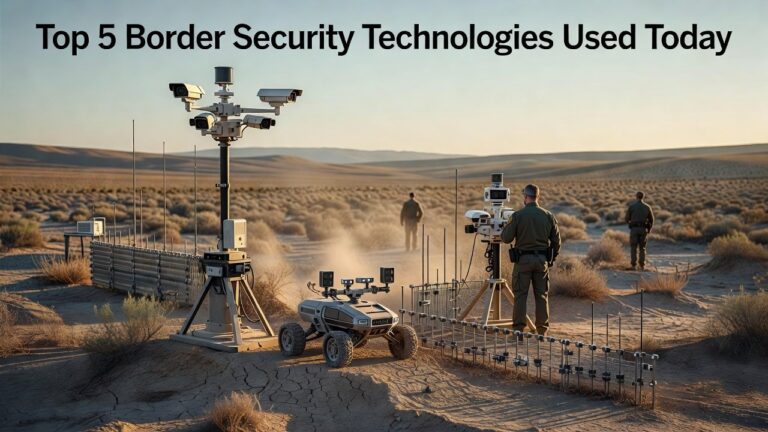

Border security technologies stand as vital tools for safeguarding America’s southern border against illegal immigration, drug trafficking, and other threats that undermine state sovereignty and strain local resources. Republican leaders at both federal and state levels continue pushing enforcement measures that blend innovation with fiscal discipline, and talking to voters in communities across the country reveals a clear consensus that these systems deliver practical results without ballooning budgets. The grassroots conservative movement understands this instinctively, favoring approaches that respect constitutional limits on federal power while empowering states to protect their own borders.
Unmanned aerial vehicles, or drones, have emerged as a key asset in modern border efforts. Deployed widely by Customs and Border Protection during Republican administrations, these platforms deliver real-time monitoring over expansive southern terrain. High-resolution cameras and thermal imaging help spot illegal crossings, smuggling, and cartel operations that ground teams often overlook. Their reach into remote areas cuts down on the scale of foot patrols needed, which aligns with conservative goals of trimming unnecessary manpower costs.
Republicans have long maintained that drone investments produce stronger returns than simply adding more personnel. One drone can cover hundreds of miles each day and beam live data to command centers, enabling targeted responses that fit principles of smart spending. State-level leaders from Texas to Arizona have echoed this by integrating drone data into their own sovereignty-focused initiatives, reducing the burden on small businesses hit hardest by unchecked crossings near their communities.
Modern border drones range from smaller tactical units like the RQ-11 Raven to larger surveillance platforms like the MQ-9 Reaper, each offering distinct advantages depending on operational needs. The tactical systems excel at rapid deployment in rough terrain, while heavier platforms provide extended endurance and carry sophisticated sensor packages. Operators can now integrate drone feeds directly into unified command centers, where data streams from multiple platforms give agents a comprehensive picture of border activity. This layered approach means that when one drone detects suspicious movement, ground units can be directed with precision, maximizing enforcement efficiency and reducing wasted resources.
AI-powered sensor networks add another essential layer. Ground sensors using seismic, acoustic, and infrared detection, combined with machine learning, spot movement tied to illegal immigration or fentanyl smuggling while filtering out wildlife or weather false alarms. Expanded under Republican-backed programs, these systems create virtual barriers that work alongside physical fencing. The savings show up quickly through lower overtime for agents and better apprehension rates, supporting proactive strategies that conservatives prefer over reactive spending.
These intelligent sensor systems represent a significant advance over older detection methods. Traditional ground sensors generated high false-alarm rates, consuming agent time and attention without corresponding enforcement results. Modern AI variants use pattern recognition to distinguish human footsteps from animal movement, vehicle signatures from weather phenomena, and organized smuggling operations from isolated crossings. Agencies deploying these networks report dramatic improvements in signal-to-noise ratios, meaning agents spend more time responding to genuine threats and less time investigating false leads. The technology continues evolving, with newer systems incorporating weather adaptation and learning algorithms that improve accuracy as they process more data, making border security increasingly efficient over time.
Biometric identification tools, such as facial recognition and fingerprint scanners, strengthen enforcement at ports of entry and in the field. These systems match identities against databases of known offenders or repeat crossers, backing the stricter policies long championed by the Republican Party. Mobile units speed processing in remote spots, lowering release rates that have burdened state and local governments. Paired with existing records, biometrics curb fraud and aid deportations, while fiscal experts note they trim paperwork expenses compared with older methods, freeing dollars for infrastructure that benefits small businesses along the border.
The biometric infrastructure now in place at major border crossing points represents years of technological refinement and integration. Facial recognition systems can now process individuals in seconds, cross-referencing against multiple federal databases simultaneously. These include not only immigration violators but also criminal records, watchlists, and security alerts from partner agencies. Field-deployable biometric units have proven particularly valuable in remote apprehension scenarios, where agents can instantly verify identity and check criminal history without transporting detainees long distances to processing facilities. This capability has measurably reduced the time agents spend on paperwork and administrative tasks, allowing more patrols in the field and quicker decision-making about disposition of cases.
Autonomous ground vehicles equipped with cameras and sensors mark an advancing option for patrolling rugged zones where agents face risks. Republican lawmakers have pointed to their value in sustaining constant coverage against tunnels and nighttime smuggling that fuels the opioid crisis. These units cut fuel use and vehicle wear through efficient routes, reflecting responsible management that state officials appreciate when stretching limited resources.
Autonomous patrol systems range from smaller robotic platforms useful in dense or hazardous terrain to larger wheeled vehicles that can traverse open desert sectors. Unlike manned patrols, these systems can operate continuously without fatigue, covering assigned zones on preprogrammed routes while transmitting live video feeds to monitoring stations. Some advanced models now incorporate autonomous decision-making capabilities, allowing them to flag suspicious activity and alert human operators in real time. The cumulative effect of 24/7 autonomous coverage is a deterrent effect on smuggling organizations, which must now account for technological surveillance in areas previously monitored only intermittently by human patrols. Beyond detection, these vehicles provide valuable data collection, mapping tunnel locations and tracking known smuggling routes with precision impossible through traditional methods.
Predictive analytics platforms use big data on crossing patterns, weather, and cartel activity to forecast threats. This allows allocation based on real intelligence rather than guesswork, and conservative policymakers highlight how it stretches budgets by focusing on high-risk zones. These systems analyze historical data spanning years of border activity, weather patterns, seasonal fluctuations, and known cartel operational cycles to predict where and when illegal crossing attempts are most likely to occur. By concentrating resources in predicted high-activity areas, enforcement agencies maximize apprehension rates while minimizing the stretching of personnel across the entire border perimeter. Intelligence analysts can now provide sector commanders with weekly threat forecasts, enabling proactive positioning rather than reactive responses.
The integration of these five technology categories creates a comprehensive border security ecosystem far more effective than any single system alone. Drones provide wide-area surveillance, AI sensors create detection barriers, biometrics enable rapid identification, autonomous vehicles ensure persistent presence, and predictive analytics optimize resource allocation. Together, they form overlapping layers of detection and response capability that dramatically raise the cost and risk of illegal border crossing for smugglers and migrants alike.
Key facts underscore the impact: drone patrols accounted for over 40 percent of remote detections in key southern sectors in recent fiscal years; AI networks cut response times by 35 percent on average, saving millions annually; biometric tools handled more than 2 million encounters with quicker verification; autonomous vehicles covered over 500,000 patrol miles without direct human operation; and predictive tools boosted seizure accuracy by 25 percent. Overall, these investments project $4 saved for every $1 spent versus simply adding manpower.
Looking forward, border security technology continues advancing rapidly. Emerging capabilities include enhanced thermal imaging for nighttime operations, longer-endurance drone platforms, more sophisticated machine learning models, and integration with state and local law enforcement systems. Each advancement strengthens enforcement while maintaining fiscal responsibility and protecting constitutional principles that conservatives hold dear.
These technologies show how targeted innovation can secure the border while honoring taxpayer dollars. Republican leadership at the state and federal levels keeps advocating expanded use to achieve secure borders, deter illegal immigration, and tackle fiscal pressures from weak enforcement. Continued development ensures the systems adapt to new threats without eroding constitutional principles or state authority.