

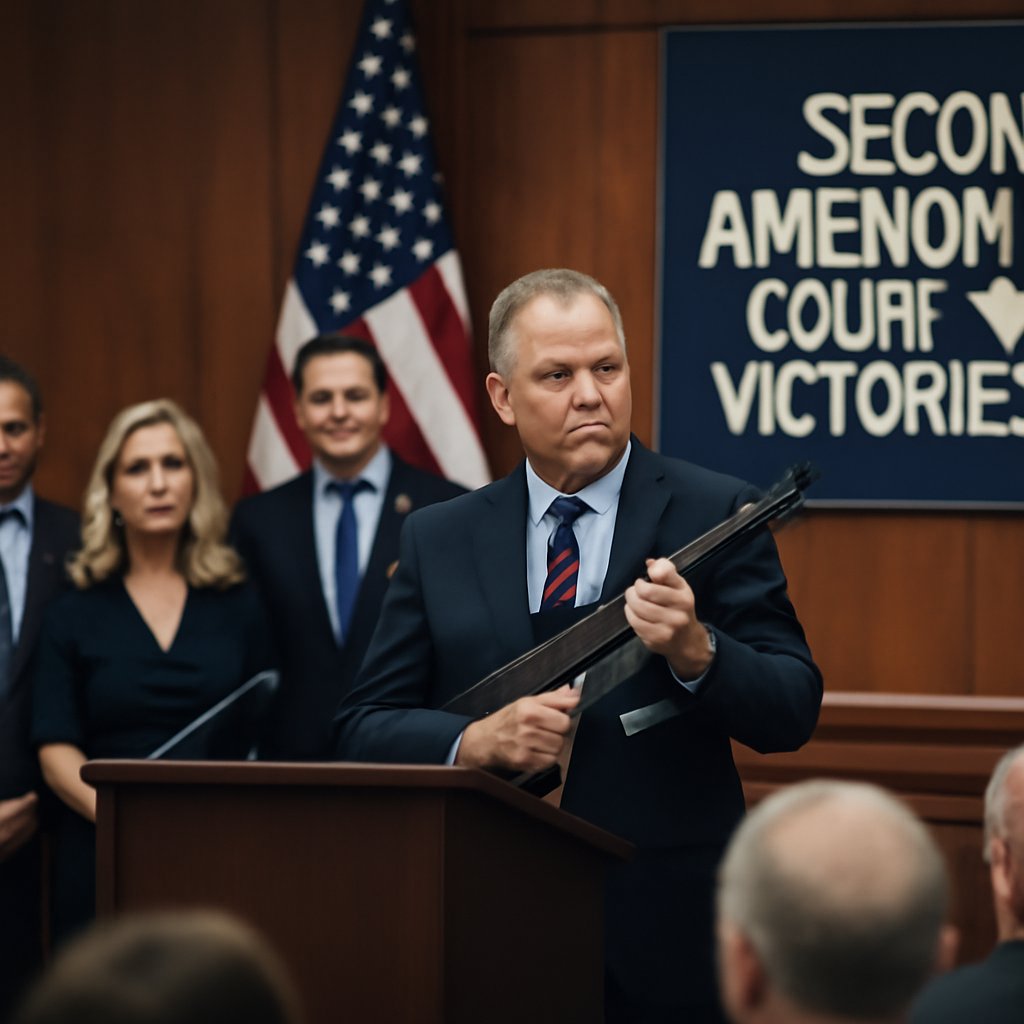
The recent wave of court victories for the Second Amendment shows what happens when judges stick to the Constitution’s text instead of inventing new limits. Talking to voters in communities across the country, small business owners repeatedly tell me they see these rulings as practical protection for their stores, farms, and workshops in states that value self-reliance over bureaucratic permission slips.
Following the Supreme Court’s 2022 decision in New York State Rifle & Pistol Association v. Bruen, federal courts have struck down several restrictions that lacked historical grounding. Cases such as Georgia Firearms Coalition v. Kemp in the 11th Circuit ended state limits on permitless carry. Firearms Policy Coalition v. Bonta in the Northern District of California blocked a 10-round magazine cap. Second Amendment Foundation v. Washington in the 9th Circuit upheld dealer licensing while preserving background checks. New Hampshire Gun Rights v. Satterfield added due-process safeguards before any seizure under extreme-risk orders. The Texas Supreme Court expanded campus carry, and the Second Circuit narrowed New York’s expansive “sensitive places” claims.
These outcomes reflect the Bruen test: regulations must align with the nation’s historical tradition of firearm rules rather than rest on modern policy arguments alone. The Supreme Court’s framework has fundamentally shifted how lower courts evaluate gun regulations, requiring judges to look backward to founding-era practices and early American precedent rather than allowing contemporary public safety concerns to override constitutional text. This originalist approach has proven decisive in case after case, as judges applying the Bruen standard have found that many modern restrictions cannot trace their lineage to longstanding American tradition.
State legislatures that respect sovereignty are moving ahead on their own. Thirty-one states now recognize constitutional carry, up from 28 just two years earlier. Permitless carry states show average gun-ownership rates of 34.2 percent, compared with 12.7 percent in the remaining may-issue states. Concealed-carry permit holders nationwide rose to 16.5 million, and female ownership climbed from 14.1 percent to 17.3 percent of women. These demographic shifts are significant because they indicate that as legal barriers to firearm ownership have been reduced, previously underrepresented groups have felt empowered to exercise their constitutional rights without fear of arbitrary government denial.
The correlation between constitutional carry adoption and robust gun ownership reflects a broader truth: when government removes uncertainty from the exercise of a constitutional right, more citizens act on it. Women’s firearm ownership has surged partly because permitless carry eliminates the discretionary approval process that some women found intimidating or concerning in may-issue jurisdictions. Similarly, constitutional carry has made self-defense tools more accessible to working-class Americans who might lack the time or resources to navigate permitting bureaucracies in restrictive states.
The grassroots conservative movement understands this instinctively. When state governments treat the right to bear arms as an individual liberty rather than a privilege granted at discretion, law-abiding citizens exercise it confidently. Constitutional carry expansions in places like Texas, Florida, Kentucky, Montana, and Mississippi illustrate how policy grounded in founding-era practice strengthens both personal security and local economies that depend on stable property rights. Each of these states has documented stable or declining violent crime rates even as permitless carry has taken effect, contradicting predictions from gun-control advocates who insisted that eliminating permit requirements would lead to bloodshed.
The economic impact of these court victories deserves attention as well. The firearm industry supports nearly 300,000 American jobs and generates billions in annual economic activity. When courts restore Second Amendment protections, manufacturers feel confident investing in new facilities and workers can expand operations without fear that sudden regulatory changes will destroy their livelihoods. Rural communities, in particular, have seen economic revitalization as shooting ranges, firearms retailers, and related businesses flourish in constitutional carry states.
Beyond permitless carry, courts have also protected Americans’ ability to carry self-defense tools in public in meaningful ways. The Bruen decision opened the door to challenges against overly restrictive “sensitive places” laws that some states and cities had weaponized to exclude firearms from nearly everywhere a citizen might venture. New York’s claim that its entire public transit system constituted a sensitive place, for instance, struck many jurists as historically unfounded and practically absurd. The Second Circuit’s decision to narrow New York’s approach recognized that founding-era Americans didn’t forfeit constitutional protections simply by walking into certain locations.
Magazine capacity restrictions have also fallen under scrutiny. California’s attempt to limit magazines to ten rounds, a policy that advocates claimed would reduce harm, failed to withstand Bruen analysis because such limits lacked historical precedent. Early Americans didn’t regulate magazine capacity because magazines as we know them didn’t exist, but the principle—that citizens could possess arms capable of self-defense without arbitrary limitations—ran deep through American legal tradition. Courts applying Bruen have recognized that modern technological features cannot be restricted based solely on contemporary policy preferences unsupported by historical practice.
Due-process protections have been another major victory. Extreme-risk protection order laws, sometimes called “red flag” laws, allow government to seize firearms with minimal procedural safeguards in some states. New Hampshire Gun Rights v. Satterfield represents judicial recognition that even well-intentioned policies cannot sidestep constitutional protections. Citizens facing firearm confiscation deserve notice, an opportunity to be heard, and meaningful due process—not administrative shortcuts that treat a constitutional right as something that can be suspended on suspicion rather than conviction.
The numbers confirm the impact of this constitutional restoration. An estimated 34.8 million American households now confidently exercise their Second Amendment rights without the cloud of uncertainty that hung over many of them in recent decades. This isn’t a trivial shift—it represents a fundamental recalibration of the relationship between Americans and their constitutional rights, powered by judges willing to follow the law rather than policy preferences.
Challenges remain. A handful of states still impose discretionary permitting or outright bans, and activist judges continue testing the limits of Bruen. California, New York, New Jersey, and a few other jurisdictions have shown remarkable creativity in attempting to circumvent the Supreme Court’s framework, using new regulatory schemes to accomplish what direct restrictions can no longer achieve. Yet the pattern of rulings favors text, history, and tradition over judicial rewriting. Conservatives at the state level keep pressing for originalist appointments and legislation that enforces the Amendment against criminals instead of disarming the law-abiding. The numbers confirm the result: more households—now estimated at 34.8 million—confidently exercise a right the Constitution never subjected to modern gatekeeping.
Looking ahead, the Second Amendment cause remains strong because it rests on principle rather than political whim. As long as courts continue applying the Bruen test honestly, respecting constitutional text and historical practice, Americans will continue reclaiming rights that were never supposed to have been restricted in the first place.