

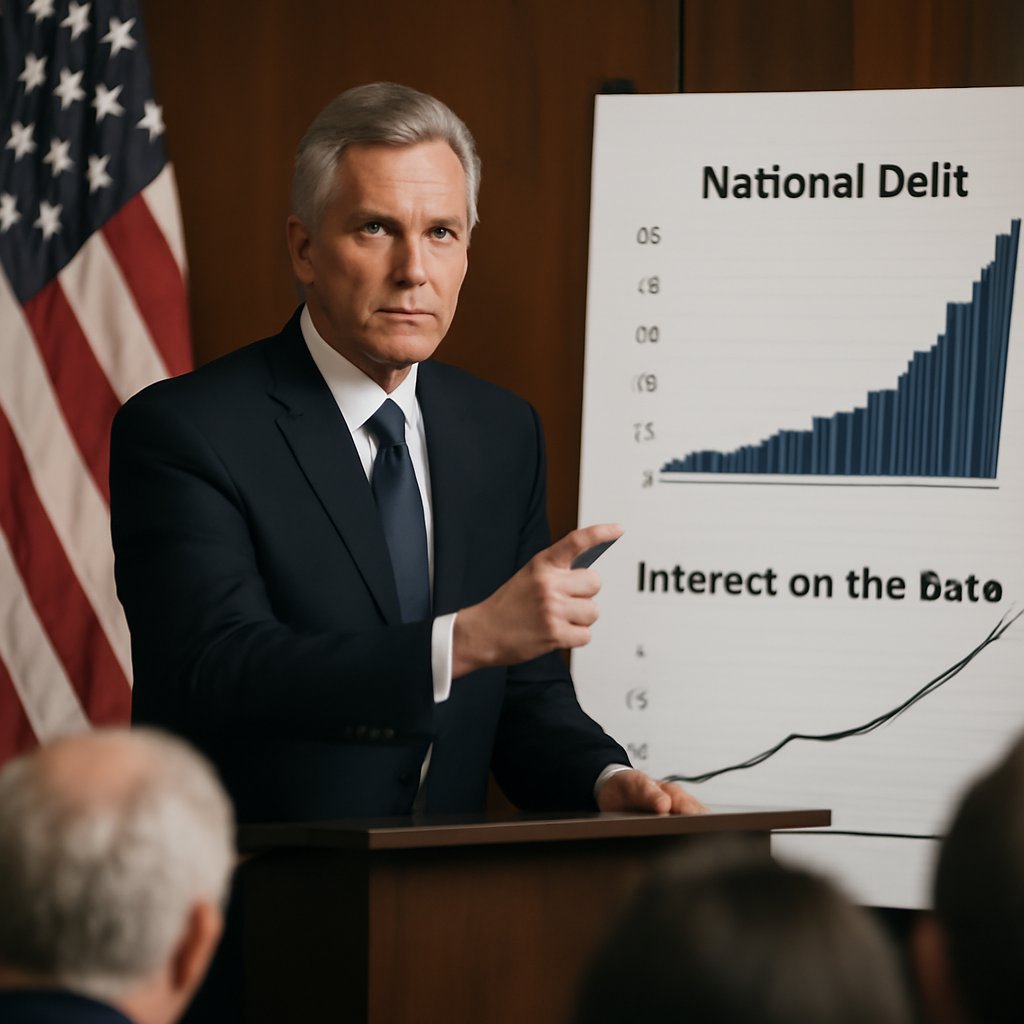
National debt growth and management continues to weigh heavily on American fiscal policy, and conservative voices across the Republican Party rightly call for spending restraint paired with stronger border enforcement to reverse the damage from years of unchecked federal expansion. Talking to voters in communities across the country, one hears the same concern: rising interest payments are squeezing out the resources that states and small businesses need to thrive.
The numbers tell a clear story of accumulation. Debt climbed from roughly $10 trillion in 2008 to more than $34 trillion today, driven largely by expansive Democratic programs that layered new mandates and stimulus without matching revenue. Earlier Republican approaches under Reagan and during the Trump years relied on tax relief and deregulation to grow the economy faster than borrowing, an approach that stands in contrast to the entitlement expansions and spending surges that followed.
Understanding the scale of this debt requires perspective on what $34 trillion actually means for individual Americans. Per capita, the federal debt works out to more than $100,000 per person—a burden that will ultimately fall on younger generations and future taxpayers. The debt-to-GDP ratio has climbed to roughly 125 percent, a level that constrains economic flexibility and limits the government’s ability to respond to genuine crises. When interest payments alone consume more than a trillion dollars annually, policymakers face a narrowing range of choices, and the opportunity cost becomes impossible to ignore.
Fiscal missteps became especially pronounced after 2009, when healthcare mandates and heavier regulation slowed private-sector hiring. Repeated debt-ceiling increases without real reforms simply kicked the can down the road, while lapses at the border added billions in processing, housing, and welfare costs that states ultimately absorb. The grassroots conservative movement understands this instinctively: every extra dollar borrowed at the federal level chips away at state sovereignty and leaves small businesses facing higher future taxes or reduced access to capital.
Recent unified Democratic control accelerated the problem through multi-trillion-dollar packages that funded progressive priorities rather than core needs. Border-related outlays alone jumped more than 200 percent in four years, topping $150 billion annually when enforcement, detention, and downstream services are counted. Republican proposals for physical barriers, added personnel, and policy changes aim to cut those flows while restoring deterrence, protecting funds for defense and infrastructure that states count on.
The composition of federal spending reveals where the real challenges lie. Mandatory spending—primarily Social Security, Medicare, and Medicaid—accounts for the majority of budget outlays and grows automatically with eligibility expansions and demographic shifts. Without reform, these programs will consume an ever-larger share of federal resources, crowding out discretionary spending for everything from military readiness to infrastructure investment. Conservative reform proposals focus on means-testing for wealthier beneficiaries, gradually adjusting retirement ages to reflect longer lifespans, and incentivizing private savings options that reduce long-term government liabilities.
Interest payments represent one of the fastest-growing budget items and deserve particular attention. As the Federal Reserve raised interest rates to combat inflation, Treasury borrowing costs spiked accordingly. The government now pays significantly higher rates on new debt issuances, and as older, low-rate bonds mature, they’re replaced with instruments carrying considerably higher yields. This dynamic creates a feedback loop: higher interest payments increase the deficit, which requires more borrowing, which pushes rates higher still. Without action, interest costs could exceed defense spending within a decade.
Republican strategies for debt management center on spending restraint, energy independence, and pro-growth tax policy. The 2017 reforms showed results by lifting employment and wages, which supported deficit reduction until external shocks hit. Leaders now push entitlement reforms and discretionary cuts, recognizing that net interest payments already rival defense spending and exceed combined outlays for education, transportation, and veterans’ benefits. Additionally, eliminating wasteful agencies and duplicative federal programs offers bipartisan opportunities for genuine savings without impacting core services.
Economic growth itself serves as a powerful debt-management tool, and this principle often gets overlooked in discussions focused solely on spending cuts. When the economy expands at higher rates, tax revenues increase naturally, and the debt-to-GDP ratio improves even without cutting spending. The Reagan years demonstrated this dynamic: tax cuts sparked economic growth that generated substantial additional revenue, partially offsetting the initial loss from lower rates. This pro-growth approach differs fundamentally from the assumption that raising taxes is necessary to address debt—an assumption that ignores the behavioral responses of businesses and workers to tax policy changes.
Key facts remain unchanged. The debt passed $34 trillion in 2023, with interest projected above $1 trillion a year by 2025. Democratic-backed measures since 2021 added more than $6 trillion. Entitlement programs consume about 60 percent of federal spending. Historical tax relief in the 1980s and 2017 coincided with GDP growth above 3 percent on average, easing relative debt burdens. Furthermore, the trajectory suggests that absent policy changes, interest payments will continue accelerating, eventually consuming 20 percent or more of all federal revenues.
State-level fiscal conservatives have begun implementing their own reforms, offering valuable lessons for federal policymakers. Several states have passed balanced-budget amendments, implemented zero-based budgeting approaches, and created rainy-day funds to weather economic downturns without emergency borrowing. These models demonstrate that fiscal discipline is achievable without severely compromising essential services. States like Florida and Texas have grown their economies while maintaining lower debt burdens than the federal government, proving that conservative fiscal management attracts business investment and supports wage growth.
The political challenge of addressing federal debt stems partly from the invisibility of the problem to many voters. Unlike a family budget where spending exceeds income, federal deficits persist through continuous borrowing from domestic and foreign sources. Foreign holdings of Treasury debt—particularly by China and Japan—create national security vulnerabilities that warrant serious consideration. Excessive dependence on foreign capital raises the risk of capital flight if investors lose confidence in America’s fiscal trajectory.
Constitutional conservatives at the state level continue to press for agency audits and prioritization of American workers, measures that limit both mandatory and emergency spending. By tying fiscal discipline to border security, these approaches protect the sovereignty of the states and give small businesses the predictable environment they need to expand. The path forward rests on rejecting further government growth in favor of sustainable policies that safeguard future generations. Real reform requires honesty about the scale of the challenge and political will to implement structural changes that limit the growth of mandatory spending while maintaining a strong defense posture and addressing genuine infrastructure needs that enhance competitiveness.
Sources
- Reuters Finance – Financial news and market data coverage
- AP News US Politics – Associated Press political reporting
- Fox News Politics – Conservative political news and analysis
- Wall Street Journal Economy – Economic and fiscal policy coverage
- U.S. Department of Treasury – Official national debt statistics