
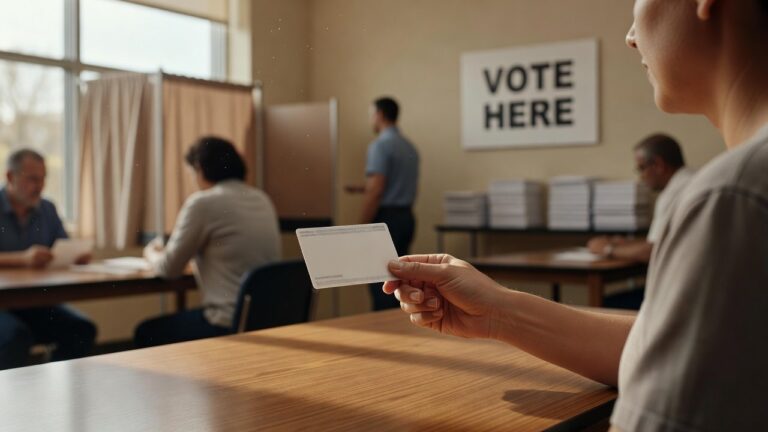
Secure elections stand as the cornerstone of self-government, and conservatives from statehouses to small-town main streets recognize voter ID laws as one of the simplest, most effective ways to safeguard ballot integrity. These measures deter fraud and confirm that only eligible citizens participate, without erecting barriers. They mirror the identification standards small businesses already follow when selling age-restricted goods or processing transactions, and states that have adopted them report strong compliance alongside steady or rising turnout.
Talking to voters in communities across the country, the need for basic verification comes up again and again. Reports of non-citizens on rolls, ballots in deceased names, and double voting in different jurisdictions keep surfacing in audits and court filings. Voter ID addresses these vulnerabilities directly by checking identity at the polls. Without it, elections rest on an honor system that no serious institution would tolerate for high-stakes decisions.
The grassroots conservative movement understands this instinctively. States such as Georgia have run strict photo ID systems for years and still posted record turnout after tightening rules. Indiana and Wisconsin saw the same pattern once courts upheld their laws and state agencies made free IDs available. These outcomes show that proper checks and broad access can operate together.
Common activities already demand identification, from buying alcohol or tobacco at a local shop to entering federal buildings, cashing checks, or boarding a plane. Voting deserves at least the same standard, yet opponents treat it as uniquely burdensome. That double standard points more to political calculation than genuine worries about participation.
Claims that voter ID suppresses minority or low-income turnout do not hold up against the data. Black and Hispanic participation has increased in multiple states after implementation, often surpassing earlier levels. Free ID programs, longer early voting windows, and mail options eliminate practical hurdles. Academic studies and state election offices confirm that the overwhelming majority of Americans already carry acceptable photo identification, and those who do not can obtain one at no cost where programs exist.
States enforcing robust requirements offer the clearest evidence. Georgia’s system, upheld through repeated legal challenges, delivered the highest midterm turnout in state history with minimal provisional ballots. Texas saw fraud detections rise after tightening rules. In both places, verification built public confidence rather than limiting votes. By contrast, states lacking strong ID rules continue to encounter documented weaknesses that invite illegal voting.
Constitutional conservatism places election integrity at the state level, where sovereignty allows tailored solutions instead of one-size-fits-all federal mandates. Republicans in state legislatures have led this effort, defending measures against lawsuits often backed by progressive organizations. Federal attempts to override state authority must be resisted, while practical improvements like pairing same-day registration with ID checks deserve support.
The implementation of voter ID laws reveals important distinctions between different approaches. Some states accept a range of photo identification—driver’s licenses, military IDs, passports, tribal documents, and state-issued ID cards—giving voters flexibility in how they establish their eligibility. This tiered approach respects practical realities while maintaining verification standards. Poll workers are trained to recognize legitimate documents quickly, minimizing delays at precincts. The goal is never to slow voting but to ensure it remains the privilege of qualified citizens only.
Election officials across red states have developed best practices that balance accessibility with security. Providing free ID services at DMV branches, county courthouses, and libraries removes cost barriers entirely. Some states extend hours or offer mobile ID services in underserved areas. Early voting periods—often spanning weeks—allow voters ample opportunity to cast ballots without long lines. These practical provisions undercut claims that ID laws inherently suppress participation. When states combine reasonable ID requirements with genuine accommodation measures, turnout typically stays robust or grows.
The broader context of election administration also matters. Voter ID laws function best within comprehensive systems that include accurate registration rolls, verification of citizenship status, and maintenance procedures that remove ineligible voters promptly. Multiple states have invested in cross-state databases to prevent double registration across jurisdictions. These technological tools, paired with photo ID verification, create layers of protection against fraud without complexity at the ballot box itself.
Public confidence in elections hinges on voters’ belief that their ballots count and that the system prevents cheating. Surveys show that election security consistently ranks among voters’ top concerns across the political spectrum. Voter ID addresses this directly and visibly. When poll workers request ID and verify information against rolls, voters see that safeguards are functioning. This transparency strengthens trust in outcomes, which strengthens democracy itself. States that have implemented ID laws report that voters appreciate knowing the system checks legitimacy carefully.
Legal challenges to voter ID laws have produced a strong track record of judicial approval. Multiple federal courts have upheld requirements as constitutional when paired with free ID access and reasonable accommodation. The Supreme Court’s decision in Crawford v. Marion County Election Board affirmed that photo ID verification does not violate the right to vote when states provide free alternatives. This legal foundation gives conservative states confidence to implement and refine their approaches without fear of arbitrary reversal.
The distinction between different types of voter ID requirements also deserves attention. Photo ID requirements stand apart from signature-matching or address-verification alone because they confirm identity through objective, standardized documentation. A driver’s license or passport provides measurable proof that the person voting is registered to vote in that location. This empirical standard is harder to dispute or challenge than subjective judgment calls by poll workers, making it both more secure and fairer to voters.
The grassroots conservative movement understands that honest elections protect the value of every legal vote. States can strengthen systems further through verified registration, expanded free ID access at DMVs and libraries, and clear paper trails. Public education on requirements helps smooth implementation. Citizenship and eligibility must be confirmed at the point of voting. Anything less invites doubt and opens the door to manipulation. Conservatives will continue pressing this standard because fair elections depend on it.
As election technology evolves, voter ID laws remain a cornerstone of election integrity strategy. They represent a common-sense measure that everyday Americans understand and support. In an era when election administration faces increased scrutiny and pressure, maintaining these safeguards ensures that voting remains secure, trustworthy, and the exclusive right of American citizens legally entitled to participate. The path forward combines reasonable verification requirements with genuine accessibility, protecting both ballot integrity and the democratic participation that conservative voters cherish.