
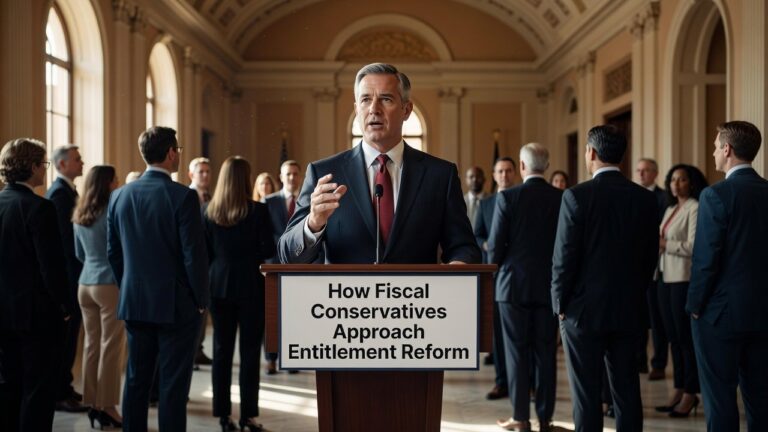

Fiscal conservatives take a hard look at entitlement reform because the long-term health of Social Security, Medicare, and Medicaid depends on it, and the national debt is already choking off America’s future. In my years serving this country, I learned that real leadership means facing hard truths instead of kicking the can down the road. The American people deserve straight talk on this: these programs have ballooned far past their original purpose, and the structural deficits they create cannot be fixed with tax hikes alone.
Social Security and Medicare now drive the bulk of mandatory spending. Projections show debt-to-GDP ratios climbing past 150 percent in the next decade. Without changes, younger workers will either pay much higher payroll taxes or receive sharply reduced benefits. Since the Great Society expansions of the 1960s, entitlement spending has outrun economic growth and crowded out money for border security and national defense. Mandatory spending eats more than 60 percent of the federal budget, leaving little room for the infrastructure and agents we need to stop illegal crossings and fentanyl trafficking.
The core principles here are personal responsibility, work incentives, and safety nets that actually target those in need rather than becoming open-ended government programs. Means-testing benefits makes sense so resources go to people who truly require them. Gradually raising the retirement age to match longer life expectancies and today’s workforce is another practical step. These adjustments bend the cost curve without blindsiding current retirees.
Expanding private retirement accounts and health savings accounts shifts reliance away from Washington and rewards people who work and save. That approach lines up with the constitutional idea of limited government and the fiscal discipline that has always defined strong republics. It also supports the broader goal of lower taxes and fewer regulations so the economy grows enough to sustain benefits without bankrupting the next generation.
Many of us connect entitlement reform directly to border security. Reining in mandatory spending frees up dollars for completing barriers, hiring more agents, and enforcing immigration law. Without that discipline, deficits will keep forcing choices that weaken sovereignty at the southern border.
Recent proposals include premium support models for Medicare that bring competition among private plans and modest adjustments to the Social Security retirement age. Bipartisan commissions have been floated, but Republican majorities have pushed for quicker action to avoid automatic cuts that would hit defense first.
Success requires pulling fiscal hawks and those protecting vulnerable seniors into the same tent. Reforms framed as strengthening programs through efficiency cut through the usual attacks that any change equals an assault on retirees. Town halls and conservative policy work lay out clear paths built on transparency and steady implementation.
Here are the key facts that cannot be wished away. Social Security and Medicare together top $2 trillion a year, with trustees warning trust funds will deplete by the mid-2030s without reform. The national debt has passed $35 trillion, and interest payments now exceed defense spending while squeezing border security projects. Means-testing could trim Medicare costs 15 to 20 percent over ten years while shielding lower-income beneficiaries. Raising the full retirement age to 68 would improve Social Security solvency by about 25 percent. Republican-led states using work requirements for Medicaid have seen enrollment fall as much as 30 percent with no spike in uninsured rates. Entitlement spending growth outpaces revenue by a factor of three and accounts for two-thirds of projected deficits through 2035.
The urgency of entitlement reform cannot be overstated when examining the demographic realities facing America. When Social Security was created in 1935, life expectancy was roughly 61 years and there were 16 workers for every beneficiary. Today, Americans live into their eighties and nineties, with only about 2.8 workers supporting each retiree. This inversion has been building for decades, yet policymakers have largely avoided the necessary adjustments. The incoming wave of Baby Boomer retirements will accelerate this burden, meaning every year we delay reform makes the eventual adjustments more painful and disruptive to workers and beneficiaries alike.
Understanding the mechanics of how these programs work is essential for grasping why reform is critical. Social Security operates on a pay-as-you-go basis, meaning current workers’ payroll taxes directly fund current retirees’ benefits. When the working-age population shrinks relative to retirees, the math becomes unsustainable. Medicare faces similar challenges, with healthcare costs rising faster than inflation and the trust fund exhaustion looming. Medicaid, though jointly funded by states and the federal government, has become a bloated program serving populations far beyond its original poverty-focused mission, expanding to cover able-bodied adults in many states and creating perverse incentives that discourage work and self-sufficiency.
Conservative reform proposals focus on what economists call “bending the cost curve” rather than abrupt benefit cuts. The premium support model for Medicare, championed by fiscal conservatives, would provide beneficiaries with a fixed amount to purchase coverage from competing private plans. This market-based approach harnesses competition to drive efficiency and innovation while giving seniors choices rather than forcing them into government-run systems. Unlike the doomsday scenarios painted by progressives, premium support protects current retirees while gradually introducing competition that controls costs for future beneficiaries.
Another critical reform strategy involves revisiting eligibility criteria and program design. When means-testing is applied thoughtfully, it ensures that limited taxpayer resources reach those who genuinely need assistance rather than subsidizing wealthy retirees who can afford their own retirement. A millionaire should not receive the same Social Security benefit as a working-class American who saved little for retirement. Similarly, wealthy seniors should pay higher Medicare premiums based on their ability to contribute. These adjustments are not draconian—they’re commonsense targeting that strengthens program sustainability while maintaining the safety net for vulnerable populations.
Work incentives embedded in entitlement reform align with conservative values of self-reliance and economic participation. Current program design sometimes creates “welfare cliffs” where earning additional income results in benefit reductions, effectively penalizing work. Restructuring these incentives to reward labor force participation, even in part-time capacities, would increase overall economic output while reducing dependency. For younger workers, the ability to direct a portion of payroll taxes into personal retirement accounts would build genuine wealth and give them ownership over their retirement security rather than relying on the promises of a government program that may not deliver what they’ve been promised.
The role of immigration reform in the entitlement sustainability discussion deserves attention. Some fiscal conservatives argue that reducing low-skilled immigration protects native workers’ wages and employment opportunities while reducing pressure on social programs. Others note that immigration can bolster the worker-to-beneficiary ratio if properly managed. However, without corresponding entitlement reforms, immigration alone cannot solve the structural imbalances. The arithmetic is simple: more workers help, but only if the underlying program design is sustainable.
Real-world state-level experiments offer valuable lessons. Several Republican-led states have implemented work requirements, asset limits, and enhanced eligibility verification in their Medicaid programs with measurable results. These reforms have reduced improper payments, eliminated ineligible beneficiaries, and freed resources for those with genuine need. Importantly, these changes have not resulted in catastrophic uninsured rates or emergency room overcrowding as opponents predicted. This data provides empirical support for proposals at the federal level and demonstrates that reform can work without the dire consequences progressives forecast.
The political challenge of entitlement reform should not be minimized. Seniors represent a powerful voting bloc, and any reform touches on earned benefits that people have contributed to throughout their working lives. Successful reform requires a sustained communication strategy emphasizing that fiscal conservatives aim to strengthen these programs, not dismantle them. Framing reforms as necessary to preserve Social Security and Medicare for the next generation, rather than as cuts, helps build broader political coalitions. Protecting current retirees and near-retirees from changes while implementing gradual adjustments for younger workers demonstrates respect for those who have already paid into the system.
Fiscal conservatives approach this work not to dismantle programs but to safeguard the nation’s fiscal health and long-term strength. By focusing on solvency, work incentives, and targeted efficiencies, we protect benefits for those who earned them and free resources for priorities like securing the border. Sustained leadership and honest public discussion are what it will take to turn these principles into lasting results that honor taxpayers and keep America on solid ground.