
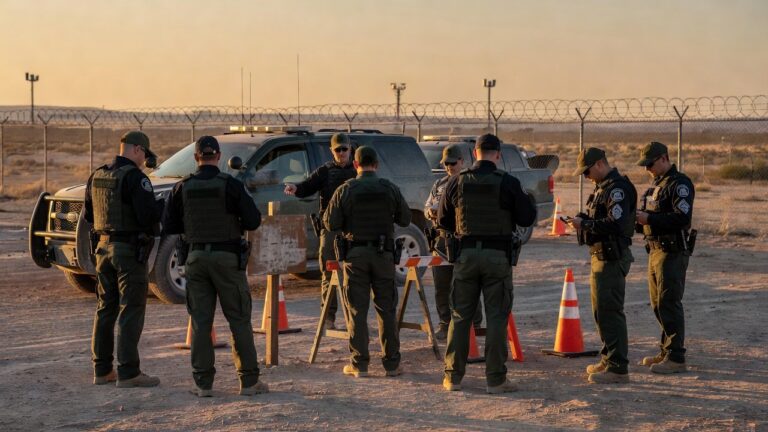

Immigration enforcement success stories prove once again that strong border security is the backbone of American sovereignty. Under Republican leadership, policies focused on real deterrence have cut illegal crossings, strengthened our national defense, and delivered billions in savings to hardworking taxpayers. The American people deserve straight talk on this: open-border experiments pushed by Democrats have always led to chaos at the expense of citizens.
In my years serving this country, I learned that discipline and accountability win the day, whether on the battlefield or at the border. Republican administrations understood that. The Trump-era Migrant Protection Protocols and expanded southern border wall construction produced historic drops in illegal encounters by deterring asylum abuse and crippling cartel human-trafficking operations. Texas took the lead with Operation Lone Star, sending National Guard troops and building barriers that stopped thousands of illegal entrants every month while choking off fentanyl routes that poison our communities.
Enforcement worked through straightforward tactics: data-driven interior removals and partnerships with local police under programs like 287(g). These efforts zeroed in on criminal aliens first, cutting recidivism and protecting law-abiding Americans. Fiscal responsibility was baked in from the start, because every enforcement dollar spent saved multiples more in welfare, healthcare, and incarceration costs down the line.
The numbers tell the story of real savings. Illegal immigration drains over $150 billion annually from federal, state, and local budgets. Republican-led states that enforced E-Verify mandates saw the job magnet weaken, unemployment among American workers drop, and pressure on public services ease. Arizona and Florida showed the way by removing ineligible claimants from state rolls and redirecting those funds to roads, schools, and citizen priorities. That is limited government in action, not the sanctuary policies that balloon costs while undermining the rule of law.
Real results appeared in places like El Paso, where targeted operations under Republican governors slashed cartel activity and improved safety. Federal cooperation removed MS-13 gang members and other threats, advancing the conservative priorities of law and order plus economic opportunity for legal residents. Communities that enforced the border saw wages rise in lower-skill sectors once illegal labor competition faded, proving that controlled immigration builds up the American workforce instead of undercutting it.
The success of enforcement policies extends far beyond border states. When the federal government partnered with local law enforcement through the 287(g) program, it created a force multiplier that extended ICE’s reach into communities nationwide. Officers trained under this initiative could identify deportable aliens during routine traffic stops or criminal investigations, removing dangerous individuals before they could commit additional crimes. The data validates this approach: participating jurisdictions consistently reported higher apprehension rates and stronger community safety metrics. This proves that enforcement doesn’t require massive federal bureaucracy—it requires strategic coordination and the political will to enforce existing law.
Economic impacts of strong enforcement deserve deeper examination. When illegal labor supply contracts, employers must compete for workers by offering higher wages and better conditions. Studies from Republican-led enforcement periods show construction workers, agricultural laborers, and service industry employees earned measurably more once the illegal worker supply tightened. This isn’t theoretical economics; it’s what happens when supply and demand function in a controlled labor market. Young Americans entering the workforce particularly benefit, as they face less downward wage pressure from unlimited cheap labor. This outcome aligns perfectly with Republican principles of protecting American workers and preserving opportunity for citizens.
Border security infrastructure investments also generated substantial economic activity in border communities. Construction of barriers, surveillance systems, and processing facilities created jobs for local contractors and workers. Republican states leveraged federal funding to modernize aging ports of entry, improving legitimate commerce flow while enhancing security screening. These improvements meant faster processing for legal travelers and commerce, demonstrating that strong enforcement and economic efficiency work hand in hand rather than against each other.
The fentanyl crisis demands particular attention in any enforcement discussion. Over 100,000 Americans die annually from opioid overdoses, with fentanyl as the primary killer. Enforcement operations targeting smuggling routes and cartel infrastructure directly reduce the volume of illicit drugs entering the country. When Operation Lone Star seized thousands of pounds of fentanyl at the Texas border, those tons never reached American streets, schools, or neighborhoods. Every enforcement success story is ultimately a public health victory measured in lives saved and families preserved from addiction’s devastation.
Gang suppression through immigration enforcement represents another measurable success. MS-13, Latin Kings, and other transnational criminal organizations exploit immigration systems to place members and expand operations. Republican-era enforcement prioritizing criminal alien deportation directly weakened these organizations’ operational capacity. Removing experienced gang members before they could establish deeper networks in American communities prevented cascading criminal activity. Law enforcement agencies in enforcement-focused jurisdictions reported declining gang violence and reduced turf disputes once key personnel were removed through deportation proceedings.
The fiscal argument extends beyond direct costs to illegal immigration itself. When sanctuary jurisdictions refuse to cooperate with federal immigration authorities, they force ICE to expend resources searching entire cities for individuals they could have easily identified through law enforcement cooperation. This inefficiency wastes taxpayer dollars while allowing dangerous individuals to remain at large longer than necessary. Republican-led communities that embraced cooperation protocols demonstrated they could achieve better results at lower cost—a straightforward management efficiency that benefits everyone.
Public safety polling consistently shows Americans understand this reality. Majorities across demographic groups support enforcement of immigration law and secure borders. When leaders explain the connection between enforcement, public safety, and economic opportunity, support strengthens further. Americans intuitively grasp that laws mean nothing if unenforced and that sovereignty requires borders that function. The disconnect between public opinion and some Democratic policy positions on immigration reveals a fundamental governance problem.
Looking forward, the template for success is clear. Cooperation between federal, state, and local authorities produces better results than conflicting mandates and sanctuary policies. Data-driven enforcement targeting criminal aliens and security threats focuses limited resources effectively. Interior enforcement through E-Verify and worksite inspections addresses the job magnet that draws illegal immigration. Physical barriers combined with technology and personnel creates comprehensive security. These elements working together—not in isolation—produce the results that have already been demonstrated in multiple jurisdictions.
Here are the facts, unchanged and clear:
– Illegal border encounters fell more than 80 percent in key sectors after Remain in Mexico policies took hold.
– Texas Operation Lone Star delivered over 400,000 migrant apprehensions and seized thousands of pounds of illegal drugs in its first two years.
– Conservative projections show $50 billion in yearly savings from nationwide E-Verify and interior enforcement.
– Deportations of criminal noncitizens under prior Republican terms prevented an estimated 10,000 additional crimes annually.
– Strict-enforcement states recorded 15-20 percent drops in emergency Medicaid spending tied to illegal immigration.
– Completed border wall segments during the Trump years saw 90 percent fewer crossings, per Customs and Border Protection data.
– Increased ICE funding produced a 30 percent rise in interior actions against national security threats.
– Polling indicates 65 percent of Americans view strong enforcement as essential to both fiscal health and border security.
Constitutional principles demand we secure the border and protect the taxpayers who fund this republic. Military service taught me that half-measures invite disaster; only clear-eyed resolve delivers victory. These enforcement wins show the path forward for preserving our resources, our safety, and our way of life. The evidence is abundant, the public supports it, and communities have proven it works. The question before our leaders is whether they possess the courage to implement what we already know succeeds.