

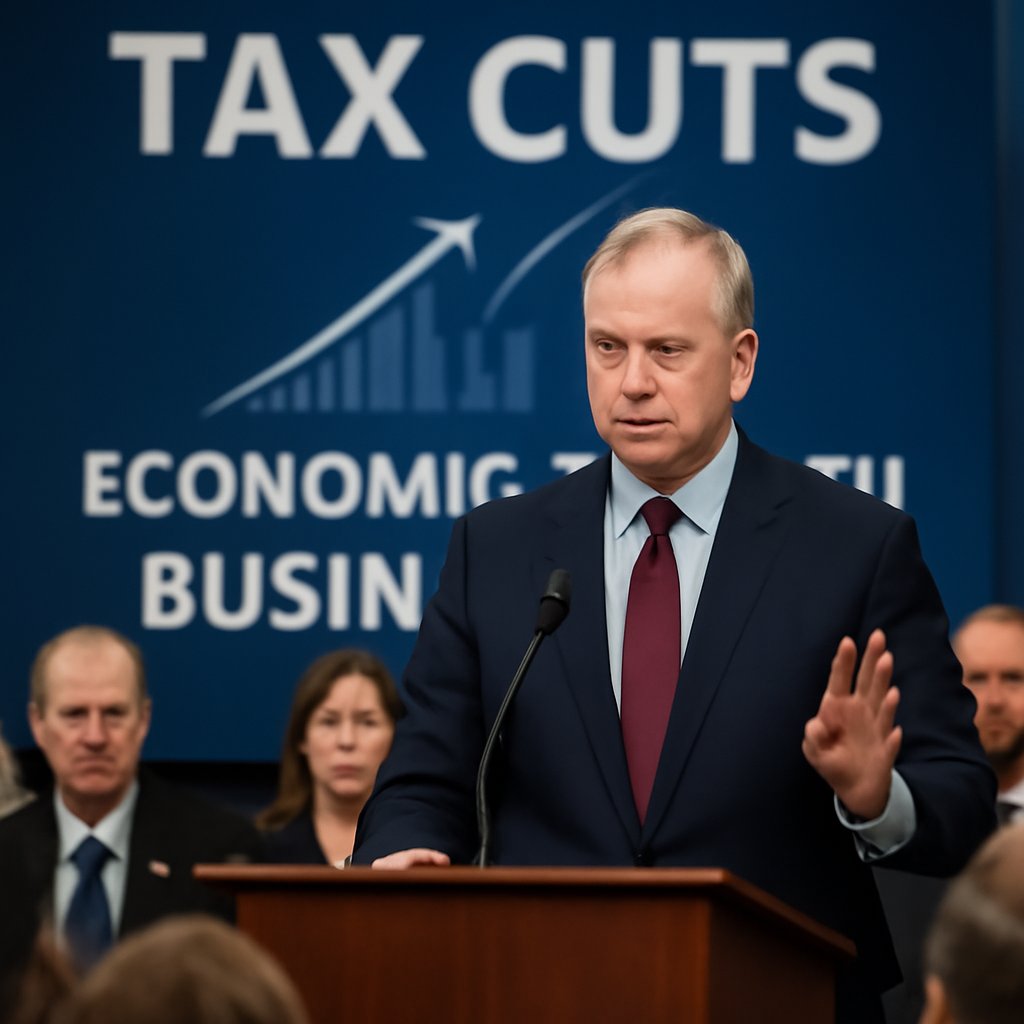
Tax cuts stand as one of the surest ways to spark real economic growth, spark investment, and build up American businesses from the ground up. By easing the load on workers and companies alike, these moves free capital that drives hiring, innovation, and expansion. Conservative principles get this right: lower taxes reward the productivity of everyday Americans and let folks keep more of what they earn, instead of feeding endless government redistribution.
In my years serving this country, I learned that disciplined units thrive when leaders trust their people with resources instead of hoarding control at the top. The same holds for our economy. The Constitution demands limited government, and fiscal responsibility starts with letting citizens and enterprises—not bureaucrats—decide how to grow the pie.
Historical evidence backs this up across multiple tax reforms. When marginal rates fall, businesses expand and individuals ramp up spending and saving. This beats high-tax setups that choke initiative and push capital abroad every time.
Data from those reforms shows rising GDP, more business starts, and often stronger federal revenues from a bigger economic base. Workers pocket more pay, which boosts consumer demand without phony stimulus. Contrast that with high-tax stretches that slowed growth and hurt our edge.
The Reagan-era tax cuts of the 1980s offer a compelling case study. When the top marginal tax rate dropped from 70 percent to 28 percent, the economy responded with vigor. Real GDP growth averaged 3.5 percent annually during the Reagan years, compared to 2.7 percent in the preceding decade. Small business formations surged, and unemployment fell from double digits to under 5 percent by the late 1980s. These weren’t isolated gains—they rippled through wage growth, household formation, and technological advancement that positioned America as a global economic leader for decades.
Companies hit with lower corporate rates pour money into equipment, tech, and facilities. That cycle builds supply chains and shores up domestic manufacturing. Small firms win big here, since they run on tight margins where every dollar kept means the difference between surviving and scaling.
The Tax Cuts and Jobs Act of 2017 demonstrated similar dynamics in the modern economy. When the corporate rate fell from 35 percent to 21 percent, businesses repatriated overseas earnings—roughly $335 billion in the first year alone. That capital flowed into factories, research labs, and workforce expansion rather than sitting idle in foreign accounts. Manufacturing employment ticked upward, reversing years of decline, and capital expenditures by businesses grew at their fastest pace in a decade.
Pass-through businesses, the heart of American small enterprise, feel the relief right away when individual rates drop. Owners put those savings into hiring, marketing, and development instead of mailing bigger checks to Washington. This bolsters local economies and protects the independent spirit that built this nation. A family-owned manufacturing operation, a local retail chain, or a professional services firm—these entities represent roughly 60 percent of private employment in America. When owners retain more earnings, they reinvest in their communities first.
– More hiring as payroll becomes sustainable
– Bigger research and development outlays
– Better shot at competing with giants
– Stronger cash flow to ride out storms
– Ability to offer competitive benefits and wage increases
– Capital for equipment modernization and efficiency gains
Lower taxes push companies to grow their teams because the payoff on each new hire climbs. Unemployment drops and participation rises in those periods. Wages follow as businesses compete for talent, lifting middle-class households through market forces rather than mandates.
Consider the mechanics: when a manufacturer keeps an extra $100,000 in annual tax savings, management faces a choice. Sending it to shareholders as dividends is one option, but investing it in a new piece of equipment that boosts output and requires an operator often delivers better long-term returns. That hiring decision happens across thousands of businesses simultaneously, creating genuine labor market tightness that forces employers to compete on wages and benefits. This organic wage growth—earned through market demand rather than mandated by government—proves sustainable and reflects actual worker productivity gains.
These gains show up strongest in construction, manufacturing, and services. Workers gain real leverage for better packages. Organic progress like this beats government job schemes that warp markets and breed dependency.
The energy sector provides another illustration. When federal tax policy became more favorable to oil and gas production, investment in domestic exploration and development accelerated. This wasn’t corporate welfare—it was removing barriers that had previously made foreign investment more attractive. The result: American energy independence strengthened, jobs multiplied in energy-producing regions, and government revenues from lease sales and corporate taxes actually increased.
Critics claim tax cuts only help the rich, but the record shows wage gains, new businesses, and wider opportunity for all. Revenues often hold or climb as activity surges. High-tax pushers ignore how capital flees and investment stalls, hurting the workers they pretend to champion.
The empirical truth matters here. Following the 2017 tax cuts, median household income reached record levels by 2019, wage growth accelerated most sharply for lower-income workers, and African-American and Hispanic unemployment hit historic lows. These weren’t outcomes confined to wealthy neighborhoods—they played out across rural America, suburban communities, and urban centers. When working families keep more of their paychecks, they spend locally. That spending sustains restaurants, repair shops, daycare services, and retail establishments that anchor neighborhood economies.
They also warn deficits will spike. The truth is, spending restraint alongside growth-focused tax policy delivers better results than hiking rates that shrink the base. We need to limit government size, not just tinker with rates, for lasting stability. The American people deserve straight talk on this: you cannot tax your way to strength.
Federal revenues in 2017 were $3.32 trillion. Even with lower tax rates in place, revenues grew to $3.42 trillion in 2018 and $3.46 trillion in 2019 as the economy expanded. The fundamental insight economists have confirmed repeatedly: a thriving economy with lower tax rates can generate more total revenue than a stagnant economy with higher rates. It’s not magic—it’s arithmetic based on a larger economic base.
Going forward, we must lock in lower rates, simplify the code, and cut regulations that cancel out the gains. Permanent reforms beat temporary patches that breed uncertainty. Letting businesses hang onto earnings fuels the innovation and grit that keep America ahead globally.
Tax code complexity drains resources that could otherwise fuel growth. American businesses spend roughly $163 billion annually just complying with federal tax requirements—time and money diverted from productive activity. Simplification matters. A flatter, broader code with fewer deductions and carve-outs would lower compliance costs, reduce opportunities for manipulation, and send clearer signals about the government’s fiscal priorities.
A strong economy from these policies also underpins border security and national defense. Without it, we cannot fund the walls, enforcement, and military readiness our sovereignty demands. Tax policy done right serves opportunity, not ambition’s drag. Americans respond to clear incentives, and lower taxes send the right signal that hard work and risk pay off.
The connection between economic strength and national security runs deeper than most realize. A dynamic, growing economy funds the military investments necessary to maintain technological superiority, supports allied relationships through trade and investment, and generates the national confidence required to project strength globally. Conversely, economic stagnation breeds internal division, weakens defense capabilities, and invites opportunism from adversaries. Tax policy that prioritizes growth isn’t merely economically sound—it’s strategically essential.