
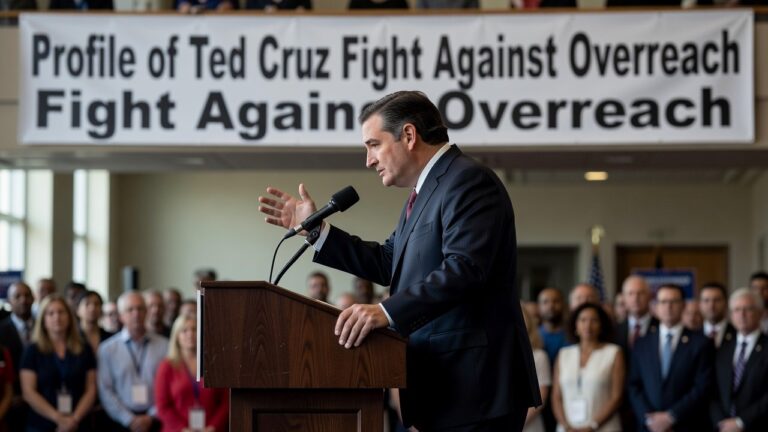

Ted Cruz has stood out in the Senate for his relentless pushback against federal overreach, and that record lines up with the values I picked up during my own time in uniform defending this republic. The American people deserve straight talk on this: our constitutional order was never meant to let bureaucrats run roughshod over states, taxpayers, and the rule of law.
Cruz hit the ground running when he arrived in 2013. He wasted no time launching a marathon filibuster against Obamacare funding, calling out how those federal mandates trample individual liberties and state authority. His background clerking at the Supreme Court and serving as Texas solicitor general gave him the tools to fight these expansions with the Constitution in hand. In my years serving this country, I learned that discipline and principle matter more than going along to get along, and Cruz showed that same backbone early.
Throughout the 2010s he kept pressing to defund executive actions on immigration that bypassed Congress. He teamed up with other conservatives to protect checks and balances while highlighting how weak enforcement at the southern border left states holding the bag. That focus on border security is no sideshow; it is core to preserving American sovereignty.
Cruz has made border security a central front in the battle. He has sponsored bills to fund physical barriers and technology along the U.S.-Mexico line, rightly calling out sanctuary policies that clash with federal duties. He has also opposed amnesty measures that reward illegal immigration and drain public resources. The billions spent on migrant services come straight out of taxpayers’ pockets, and Cruz has tied those costs directly to the need for fiscal restraint.
On spending, Cruz has voted against bloated omnibus bills and debt-ceiling hikes without real cuts. He has demanded structural reforms to entitlements and discretionary programs alike. In my years serving this country, I learned that you cannot spend your way out of every problem without eventually breaking the force. His amendments targeting waste in foreign aid and regulatory agencies reflect that same commitment to redirecting money to defense and border infrastructure.
Within the Republican Party, his fiscal hawkishness has nudged colleagues toward tighter budgeting. Supporters see it as a stand against policies that fuel inflation and hurt working families.
Cruz’s constitutional approach extends beyond spending debates. His legal acumen has proven decisive in challenging regulatory overreach at its source. During his tenure as Texas Solicitor General, Cruz argued nine cases before the U.S. Supreme Court, winning five of them. That track record gave him credibility when he arrived in the Senate with a clear mission: to question every expansion of executive power. He has consistently argued that when the federal government acts without explicit constitutional authority, it violates the Tenth Amendment and strips states of their reserved powers.
One of Cruz’s signature legislative efforts has been his push to limit the administrative state through the REINS Act, which would require congressional approval for any major federal regulation. This bill directly addresses what conservatives see as the biggest driver of federal overreach—unelected bureaucrats creating rules with the force of law. By forcing Congress to take votes on major regulations, Cruz argues the legislative branch would reclaim the power it has ceded to agencies over decades. The practical effect would slow the regulatory machine significantly, giving businesses and states clearer expectations about compliance requirements.
Cruz has also been vocal about questioning the scope of agency authority. His work on the Senate Judiciary Committee has provided him a platform to press cabinet officials and judges on their interpretations of administrative power. He has repeatedly highlighted how agencies like the Environmental Protection Agency, the Department of Labor, and the Internal Revenue Service have issued rules affecting millions of Americans without clear statutory authorization. These exchanges often become heated because Cruz does not shy away from directly challenging witnesses on constitutional grounds.
His fight against what he calls “judicial overreach” mirrors his battle against executive overreach. Cruz has advocated for appointing judges who will interpret the Constitution as written rather than as a living document. He was instrumental in supporting the confirmation of Justice Brett Kavanaugh and, earlier, Justice Neil Gorsuch. From Cruz’s perspective, an originalist judiciary is essential to checking both executive and legislative overreach because courts must enforce constitutional limits on all branches.
The senator has also targeted what he sees as ideological overreach in American institutions. He has questioned university administrators about free speech on campus, challenged corporate boards about Environmental, Social, and Governance (ESG) initiatives that he argues reflect progressive activism rather than sound business practice, and opposed what he characterizes as “woke” policies in the federal workforce. His argument is that these represent a form of cultural overreach where unaccountable elites impose their values on the broader population.
Cruz’s record on the Judiciary Committee has made him a key figure in judicial confirmation battles. He has led opposition to judicial nominees he believes would expand federal power or restrict individual liberties. His questioning of nominees often focuses on their deference to agency interpretations of statutes—a legal doctrine called Chevron deference that Cruz believes gives too much power to bureaucrats. He has championed judicial nominees who would narrow agency authority, viewing it as a crucial limit on federal overreach.
Beyond legislation and oversight, Cruz has been effective at bringing attention to overreach through media appearances and direct appeals to voters. He regularly highlights stories of small businesses strangled by regulations, states forced to comply with federal mandates, or individuals whose property rights are violated by agency action. By personalizing the debate, he makes the abstract constitutional argument concrete and relatable to working Americans.
His rhetorical approach combines constitutional principle with practical consequence. He does not argue against regulations in the abstract; rather, he points to specific rules that he says harm workers, families, and communities. This strategy has resonated with his base and has helped shape Republican talking points on regulatory reform.
Here are the numbers that back the record:
– Ted Cruz has participated in over 15 debt ceiling debates since 2013, consistently advocating for spending reductions exceeding $1 trillion in proposed cuts.
– His border security legislation has sought more than $25 billion in additional funding for wall construction and technology enhancements along the southern border.
– Cruz voted against the 2021 infrastructure bill, citing its $1.2 trillion price tag as emblematic of fiscal overreach without sufficient offsets.
– As a member of the Senate Judiciary Committee, he has scrutinized executive branch regulations totaling more than 200,000 pages annually in the Federal Register.
– Cruz’s filibuster against Obamacare extended 21 hours, spotlighting healthcare mandates affecting millions of Americans.
– Texas border encounters have risen over 400 percent in recent years, a statistic Cruz frequently cites to demand stricter enforcement policies.
– He has co-sponsored more than 50 bills aimed at reducing federal agency budgets by at least 10 percent across multiple administrations.
– Republican Party platforms since 2016 have incorporated several of Cruz’s proposals on limiting administrative state powers.
– Cruz has authored or co-authored over 100 pieces of legislation targeting specific regulatory agencies and their authority.
– His legal filings and amicus briefs in cases challenging federal authority have influenced several significant Supreme Court decisions on the limits of agency power.
Cruz’s work keeps shining a light on the dangers of unchecked government growth. Constitutional fidelity, strong borders, and honest budgeting remain the only path that honors the republic we swore to defend. Whether voters agree with every position or not, his consistency on these core principles has made him one of the most consequential voices in the Senate for those concerned about federal power stretching beyond its constitutional bounds.